Pierre Bonnard - French Post-Impressionism at The Kimbell Art Museum, Fort Worth, TX
From November 2023 to January 2024, the Kimbell Art Museum organized a fantastic exhibition of works by French post-impressionist Pierre Bonnard (1867–1947). I visited and can’t wait to tell and show you all about it!
Grab your favorite beverage, settle in, and set aside a few moments to read about my visit to the Kimbell’s latest art exhibit.
In addition to having an exceptionally high quality collection of paintings and sculptures (Michelangelo, Caravaggio, Rembrandt, Monet, Picasso, Cézanne) the museum is remarkable for its architecture. Housed in an elegant building by architect Louis Kahn, the Kimbell’s architecture with its emphasis on natural light plays a vital part in and greatly enhances your experience of the art.
(Image credit of the Kimbell Museum via KERA )
This show explored the art of Pierre Bonnard -
one of the most celebrated French artists of the twentieth century.
Known for his skilled use of intense colors, Bonnard was a member of the “Nabis” art movement in the late XIX Century, a group of artists disaffected by the rigid, representational style of painting at the time, who were interested in the decorative function of art and how art and paintings complement the interiors for which they were commissioned.
Bonnard is generally regarded as one of the greatest colorists of modern art. This is the first major exhibition of Bonnard’s paintings in Texas in nearly 40 years. The Kimbell reunited some of Bonnard’s most celebrated works spanning his whole lifetime and career of more than fifty years.
The artworks were curated from museums across Europe and the United States, as well as private collections worldwide. This was such an unique opportunity for art-lovers who enjoy vibrant, intense colors!
Interestingly, the Kimbell’s curators chose to organize the exhibit neither chronologically nor geographically, but rather by measures of intimacy - the exhibition will bring you along from the expansive landscapes of France to the most intimate spaces Bonnard inhabited - both physically and spiritually.
The exhibition begans with grand views of Paris or landscapes in the countryside: vast, expansive vistas.
It is the acquisition by the Kimbell Museum of this large painting below - 50 3/8 x 109 1/2 in. (128 cm 278.2 cm) - depicting the view Bonnard saw from a vista point just above his house, that prompted the current exhibition of his life’s work.

Pierre Bonnard “Paysage au Cannet” (Landscape at Le Cannet) 1928. This painting is first recorded hanging on the wall in Bonnard’s Paris apartment in 1930. His friend Édouard Vuillard painted a portrait there of Bonnard’s city studio, showing the artist looking intently at “Landscape at Le Cannet.”. This scene is so flooded with light. Notice how Bonnard included himself, albeit discretely, in the foreground, making this immense work also deeply personal.
Acquired by the Kimbell Art Museum in 2018, in honor of Kay Fortson, President of the Kimbell Art Foundation, 1975–2017
Édouard Vuillard Portrait of Pierre Bonnard (Portrait de Pierre Bonnard). An intimate portrait of Bonnard, painted by his very close friend, as Pierre contemplates his own painting “Paysage au Cannet” (Landscape at Le Cannet) .
Pierre Bonnard “Grande salle à manger dans le jardin” (Dining Room on the Garden) - 1934-1935. This painting, one of more than 60 dining-room scenes he made between 1927 and 1947, captures a fleeting moment of interplay between a feeling and light. The perspective is quite flattened, as it seems Bonnard was less concerned with depth than with the glow of intense colors and light.
Bonnard used sketchbooks on a daily basis. ‘A moment intensely seen and intensely felt….’ is how he described the two minute drawings that he made in these small diaries. He worked very slowly, and he worked on 4-5 paintings at one time.

Pierre Bonnard “Crépuscule” (Twilight, the Game of Croquet) 1892 Huile sur toile (Oil on canvas), Musée d’Orsay, Paris. Gift of Daniel Wildenstein through the Société des amis du Musée d’Orsay, 1985
The painting above was exhibited in 1892 at the Salon des Indépendants under the title “Twilight”. The painting shows the garden of the the Bonnards’ family home, at Le Grand-Lemps, southeast France, where he spent much of his childhood. From left to right we see the artist's father, his sister Andrée as she prepares to strike a croquet ball with her mallet. Next to her is their father in a straw hat, and in the background is Bonnard’s brother-in-law - Andrée’s husband, the musician Claude Terrasse, stands further back. In the background, five young women in white dresses are whirling in a frenzied dance. The decorative shapes and flattened patterns the artist uses here were inspired by the Japanese woodblock prints he loved.


Take a look at Bonnard himself in different stages of his life. The first picture is of him and his good friend Edouard Vuillard during a trip to Italy 1899, photographed by another of their close friends and fellow artist Ker-Xavier Rousse. On the right he is with one of his beloved dachshunds. Apparently Bonnard owned six successive dachshunds, all named Poucette, which translates loosely something like “Thumbelina” or “Little Thumb.”
Pierre Bonnard “Le Palmier” (The Palm) 1926 Oil on canvas The Phillips Collection, Washington, DC Acquired 1928. Bonnard created this painting the same year in which he and his wife Marthe purchased Le Bosquet. In front center the composition, a woman - Marthe - faces us and holds what seems to be an apple in her outstretched hand. His paintings have an abstract feeling to them, combined an interesting and unique use of color.
Images of the common interior spaces and furnishings of domestic life—dining rooms and sitting rooms, chairs, tables, baskets, vases—give way to paintings that show more private environments—the bedroom, dressing room, and bath.
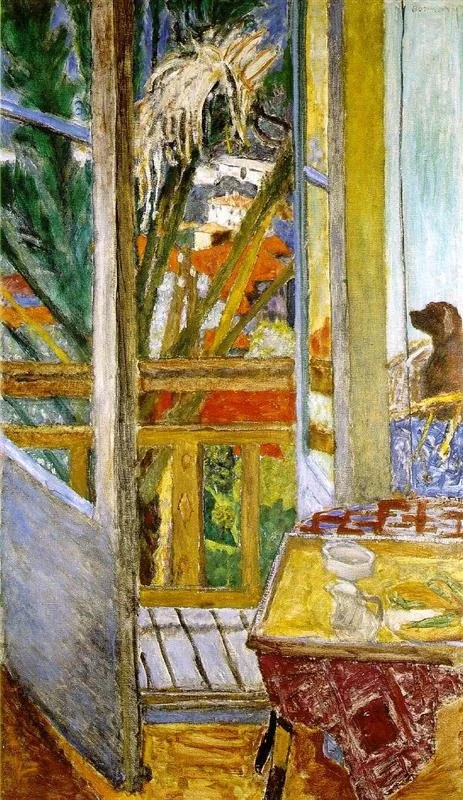

Above left: Pierre Bonnard “La porte-fenêtre avec chien” (The French Window with a Dog) 1927. Private collection, Dallas. Bonnard created Le porte-fenêtre avec chien within months of settling at Le Bosquet. The painting depicts the small sitting room on the second floor where he and Marthe took their breakfast and lunch each day. One of the couple’s pet dachshunds is visible in a mirror that hangs to the right of the open French door, keeping company with the artist as he observes the sunny interior. The dog’s reflection seems to gaze fixedly out the French door over the red rooftops of Le Cannet, directing the viewer’s attention toward the landscape vista. (Credit: Christie's)
Above right: Pierre Bonnard “Femme avec chien” (Woman with Dog) 1922, The Phillips Collection, Washington, DC . American collector and philanthropist Duncan Phillips was immediately taken with this painting upon seeing it presented at the Carnegie International exhibition in 1924. As his wife Marjorie Phillips later recalled, it “stood out like a jewel in that vast exhibition.” The painting launched the start of a major collection that grew to over 30 works by the 1950s and that now stands as the largest, most diverse collection of Bonnard’s work in an American museum. This tightly cropped view of Bonnard’s wife with a dog on her lap recalls the artist’s Nabi intimist interiors of the 1890s both in subject, patterning, and symbolist mood. Here Bonnard beautifully frames the composition through the interplay of horizontals and verticals softened by the rounded curves of the plates, bottle, and the figure of Marthe herself.
(Credit: Phillips Collection)
“And before I start to paint, I meditate, daydream”
Pierre Bonnard “Deux corbeilles de fruits” (Two Baskets of Fruit) 1935; Oil on canvas. Collection of Anne and Chris Flowers)
Tables laden with fruits and cakes; pups, garden views, and the comfort of home - the days in Bonnard’s world look like a perfect summer afternoon.
At the end of the exhibition, Bonnard’s renowned depictions of his wife bathing are followed by the most private images of all, the artist’s portraits of himself, as seen within a most private world, that of the mirror that reflects his image.
Pierre Bonnard “La Glace de la Chambre Verte” (The Mirror in the Green Room) 1908
Mirror in the Green Room brings the viewer close to the dressing table—so close that the objects resting on its surface are cropped by the picture’s edge. Bonnard calls on the viewer to look closely and attentively at his composition. He simplifies the mirror frame’s design, thus making the image it encloses a bit more noticeable. Were it not for the discreet reflection of the inside of the basin and the opening of the pitcher, the mirror might be mistaken for a framed painting, hanging against the patterned wallpaper.
Description courtesy of the Kimbell Art Museum
Image courtesy of the Indianapolis Museum of Art at Newfields.
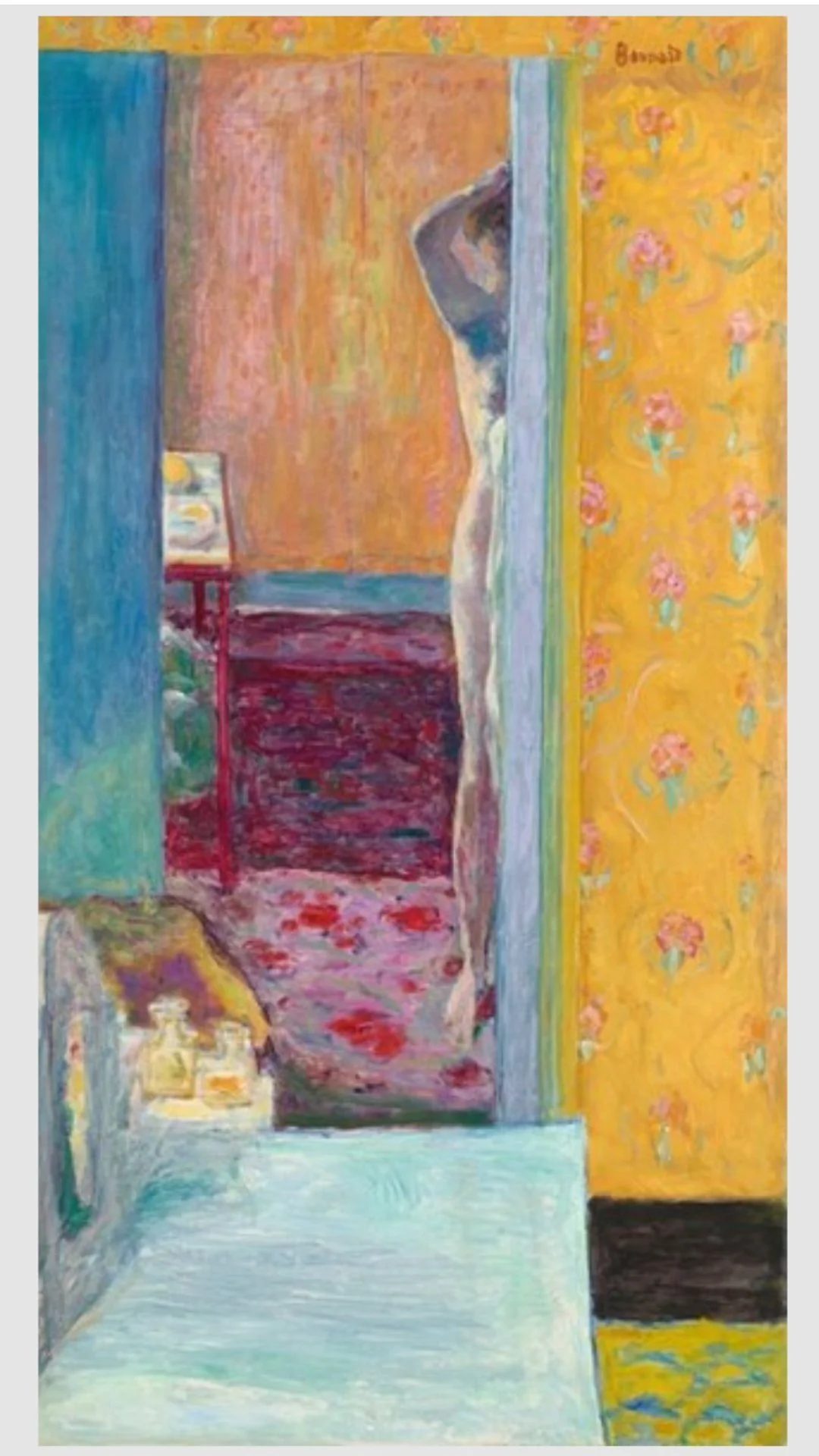
Above left: “Nu dans un intérieur”, 1912-1914 (Nude in an Interior), 1912-1914 (Washington, National Gallery of Art).
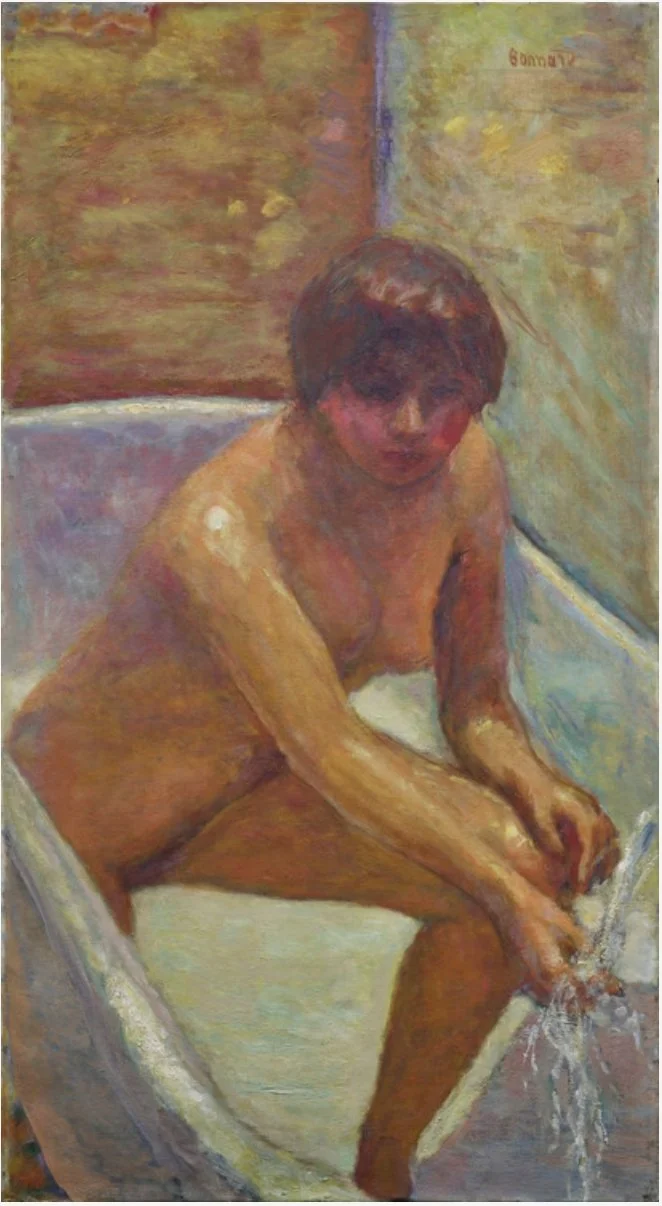
Above right: “La Source (Nu Dans La Baignoire)” The Spring (Nude in the Bath) 1917 Fondation Beyeler, Riehen / Basel, Beyeler Collection
Above, two examples of Bonnard’s most intimate work - portraits of his wife and muse Marthe. In the painting on the left - the perspective is somewhat distorted and we only see a glimpse, a subtle suggestion of the figure of a woman. We are allowed into to the most private moments at home - as we, just as Bonnard would have, are accidentally passing by a doorframe when Marthe is getting dressed after her bath.
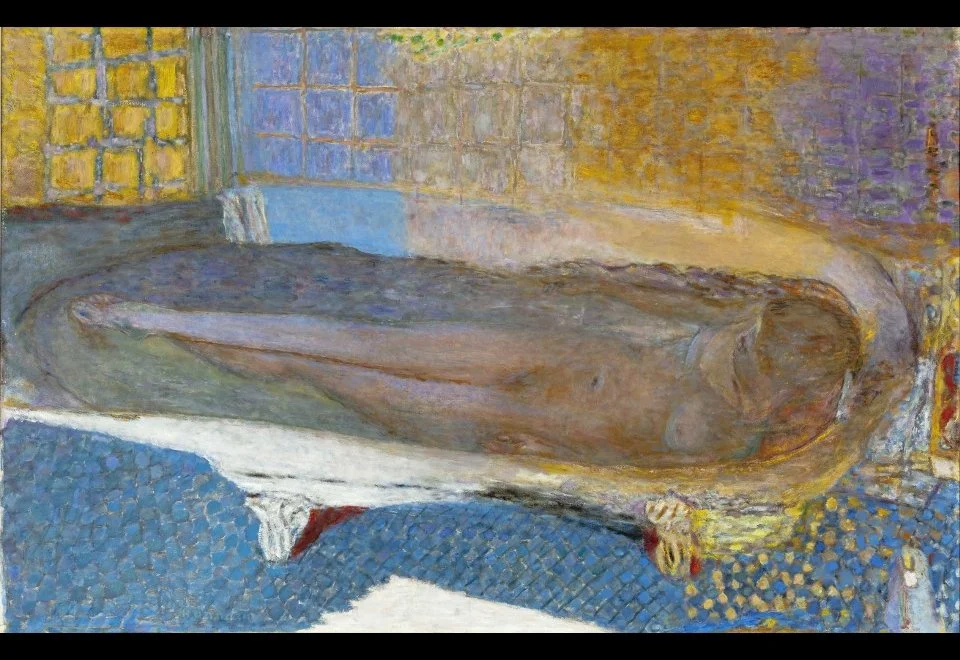
Pierre Bonnard “Nu dans le Bain” (Nude in the Bath) 1936 Oil on canvas Musée d’art moderne de Paris Purchased from the artist, 1937, for the Universal Exposition of 1937
Pierre Bonnard “Nu dans le Bain” (Nude in the Bath) 1936 The last of Bonnard’s paintings of Marthe soaking in the bath, the visionary Nude in Bathtub is also the last of the artist’s depictions of the woman who was his closest companion for fifty years. Although Marthe was still living when the painting was begun around 1940 or 1941, her death in 1942 left Bonnard without a model; the painting was completed entirely from memory and the imagination. Notwithstanding the privations of war and the anguish of loneliness, in his last years Bonnard painted some of his most ambitious and inventive works, among them Nude in Bathtub. Such paintings, no matter what shape their subjects might assume, emerged as expressions of the artist’s emotions, particularly his feelings of love.
Description courtesy of the Kimbell Art Museum
Image courtesy of the Carnegie Museum of Art
Pierre Bonnard “Autoportrait a la barbe” (Self Portrait with a Beard), 1920 - 1925. Bonnard painted at least twelve self-portraits. He appears a bit melancholy here, and the intense reds and dark colors suggest to me a tortured soul.

Pierre Bonnard Le Boxeur (portrait de l'artiste) Self-Portrait (The Boxer) 1931
At the first exhibition where this painting was shown - from January 1932 to March 2, 1942 at Bernheim-Jeune gallery (Paris) - it was presented as “The Boxer” - not as a self-portrait. His facial expression conveys sadness, or vulnerability, at least that’s what I see.
In the exhibition, you will see works from all periods of Bonnard’s long career, painted in all the places he most loved and treating all the genres in which he excelled, including landscape, still life, and figure painting. Together, they tell the story of Bonnard’s inner world and his imagination.